 hinoko
Japanese reading practice: graded stories for every level
Read this N5 story right here, or go to the N4 stories, N3 stories or N2 stories.

コンビニのおにぎり · The Konbini Onigiri
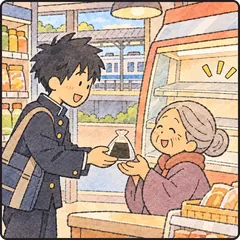
けんは まいあさ、えきの ちかくの コンビニで おにぎりを 一つ かいます。
Every morning, Ken buys an onigiri at the konbini near the station.
今日は、おにぎりが あと 一つです。
Today, there's only one onigiri left.
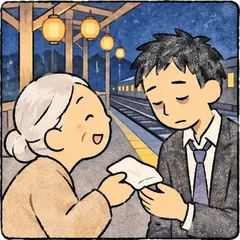
となりで、小さい おばあさんも その おにぎりを 見ています。
Next to him, a little old lady is looking at that onigiri too.
「どうぞ」
"Here you go."
けんは おばあさんに おにぎりを わたします。
Ken hands the onigiri to the old lady.
「どうも ありがとう」
"Thank you very much."
今日の あさごはんは パンです。
Today it's bread for breakfast.
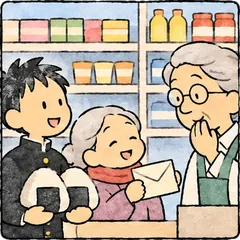
つぎの あさ、コンビニの やまださんが けんに 小さい ふくろを わたします。
The next morning, Yamada-san from the konbini hands Ken a small bag.
「これ、母からです」
"This is from my mother."
ふくろの 中には、大きい おにぎりが 二つと、てがみが あります。
In the bag, there are two big onigiri and a letter.
「きのうは ありがとう」
"Thank you for yesterday."
Did you understand?
-
1けんの 今日の あさごはんは 何ですか。
What is Ken's breakfast today?
See the answer
Answer: 2. パン (bread)
-
2やまださんの ふくろの 中に 何が ありますか。
What is in Yamada-san's bag?
See the answer
Answer: 1. 大きい おにぎりと てがみ (big onigiri and a letter)
-
3小さい おばあさんは だれですか。
Who is the little old lady?
See the answer
Answer: 3. やまださんの お母さん (Yamada-san's mother)
Tappable words, audio, questions and review.
The 32 words of this story and their meaning →Reading tips
How to practice reading Japanese ↓279 short stories written for each JLPT level, from N5 to N2. 50 are free to read, including Japanese folktales such as Momotarō and Yuki-onna, and they come first in each level.
 The 50 N5 stories
N5 in detail →15 free stories
35 more N5 stories with Premium
 The 48 N4 stories
N4 in detail →11 free stories
37 more N4 stories with Premium
 The 91 N3 stories
N3 in detail →14 free stories
77 more N3 stories with Premium

 The 90 N2 stories
N2 in detail →10 free stories
80 more N2 stories with Premium

How to practice reading Japanese
Reading is how words and grammar stick: you meet them again and again, in context, until you no longer need to look them up. Here is the method, step by step, and what to read at each level.
Extensive and intensive reading
Extensive reading, tadoku (多読) in Japanese, means reading a lot of easy texts for the story: you read quickly, without stopping, and understand almost everything. Intensive reading, seidoku (精読), means taking a short, harder text apart sentence by sentence, every word and every grammar point.
Both have their place, but not in equal parts. Give most of your reading time to extensive reading, at a level where you feel comfortable: that is where speed and vocabulary grow. Keep intensive reading for a short text a little above your level, once or twice a week, or for a sentence that keeps puzzling you.
Know about 98% of the words
How easy should a text be? In a study of reading in a foreign language, Hu and Nation (2000) found that readers needed to know about 98% of the words of a story to understand it on their own; at 90 or 95%, most of them did not. Ninety-eight percent means one unknown word in fifty, about one per paragraph.
Take the figure as a guide rather than an exact line: if you need the dictionary on every line, the text is too hard, and you will learn more by going down a level. Every hinoko story is written for one JLPT level: its kanji, and almost all its words, come from the lists of that level and the levels below, and the few words from the level above are flagged.
The four rules of tadoku
The NPO Tadoku (NPO多言語多読), which publishes graded readers in Japanese, sums up extensive reading in four rules:
- Start at a very easy level (やさしいレベルから読む).
- Read without a dictionary (辞書を引かないで読む).
- Skip what you don’t understand (わからないところは飛ばして読む).
- If a book stops moving forward, read another one (進まなくなったら、他の本を読む).
On a screen, the second rule becomes: tap a word only when the story stops making sense without it.
A little every day
One short story a day does more than a long session once a week: about 5 minutes at N5, 12 at N2. Read at the same moment every day, on the train or before bed, and stop while it is still a pleasure: the habit matters more than the amount.
When you meet an unknown kanji
Read its furigana, the small kana above it, and keep going: the sentence often gives you the meaning. If the same kanji comes back in several stories, learn the word it belongs to, with its reading, rather than the kanji alone; the kanji guide explains how.
When to hide the furigana
Leave them on the first time you read a story. Hide them on the second reading, once the kanji of your level have become familiar: you find out what you can really read. In the JLPT N3 and N2 papers, most kanji carry no furigana, so the reading tests of our N3 and N2 pages start with them hidden. The furigana guide explains how they work.
Reread, and read aloud
Read a story again a day or two later: it goes faster, and the words you guessed the first time become words you know. Then read it aloud, or follow the audio and repeat each sentence: sound and writing reinforce each other, and you notice the words you only thought you could read.
Keep the words that matter
Don’t write down every unknown word: keep the ones that come back and the ones you want to use. Review them with the sentence you met them in, at growing intervals, just before you would forget them. In hinoko, every word you tap can be kept, and it comes back for review with its sentence.
From graded stories to books and news in Japanese
Graded stories are a bridge, not a destination. Around N4 and N3, add NHK News Web Easy, the news in simple Japanese with furigana, and children’s books and manga, which print furigana on their kanji. Around N2, children’s novels, light novels and short stories come within reach. The guide to Japanese books for beginners names real titles, level by level. Other apps offer graded reading too: our comparison of Japanese reading apps shows the levels each one covers and what you can read for free.
Top to bottom, right to left
Most Japanese books are printed in vertical writing, tategaki (縦書き): you read each column from top to bottom, and the columns from right to left, so the book opens from what looks to you like the back. Manga follow the same order, panel by panel. Websites and textbooks, like our stories, are written horizontally, from left to right.
What you read at each level
The length of our stories, computed from the stories themselves, next to the longest text of the JLPT reading section at the same level (official length, in characters).
| Level | Stories | An average story | Reading time | Longest JLPT text |
|---|---|---|---|---|
| N5 | 50 (15 free) | about 355 characters, 17 sentences | about 5 min | up to 250 characters |
| N4 | 48 (11 free) | about 461 characters, 16 sentences | about 7 min | up to 450 characters |
| N3 | 91 (14 free) | about 662 characters, 21 sentences | about 9 min | up to 600 characters |
| N2 | 90 (10 free) | about 831 characters, 23 sentences | about 12 min | up to 900 characters |
Not sure of your level? Each level page starts with a short reading test in the JLPT format, with the answers explained.
Questions
Can I practice reading Japanese for free?
Yes: 50 of the 279 stories are free to read online, with no account, at every level from N5 to N2. Among them are famous folktales such as Momotarō, Yuki-onna and Issun-bōshi.
What is a graded reader?
A text written for learners of a given level, with controlled vocabulary and grammar, so that you can read it without stopping at every word. hinoko stories follow the JLPT levels, from N5 to N2. Graded readers exist on paper too: see which books to start with.
Do I need to know kanji to read these stories?
No. Every kanji has its furigana, its reading in small kana above it, and you can hide them as you progress. Reading hiragana and katakana is enough to start.
Which level should I choose?
N5 if you are starting out, N4 if you know the basics such as the te-form and the past tense, N3 if you can follow simple everyday texts, N2 if you read with ease and want natural written Japanese.
How long does it take to read a story?
About 5 minutes at N5 and 12 at N2: an N5 story has about 17 short sentences, an N2 story about 23 longer ones. One story a day is enough to make steady progress.
Didn’t find your answer?
Write to us at contact@hinoko-japanese.com: we answer in English or French.