 hinoko
おなじかさ The Same Umbrella
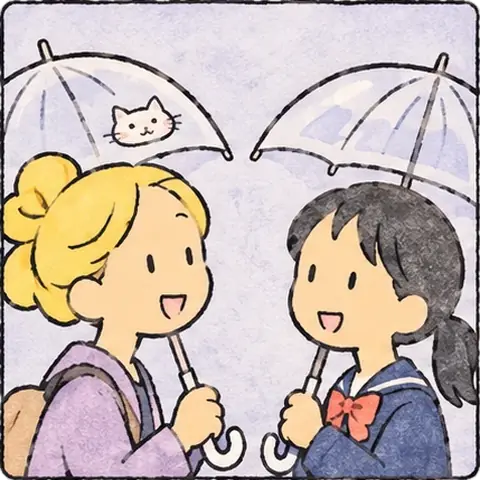
It's raining. Emma buys an umbrella at a konbini. But konbini umbrellas all look alike…
- ~5 minutes
- 16 sentences
- 360 characters
- 19 kanji
- 0 N4 words
Every word and every kanji is checked against the N5 lists; no word from a higher level. How we check →
The story
あさから 雨が ふっていました。
It had been raining since the morning.
エマは コンビニで かさを かって、きっさてんへ 行きました。
Emma bought an umbrella at a konbini and went to a café.
みせに 入る 前に、かさを いりぐちに おきました。
Before going in, she left her umbrella at the entrance.
中で コーヒーを のんで、本を 読みました。
Inside, she drank a coffee and read a book.
Rōmaji of this paragraph
Asa kara ame ga futteimashita. Ema wa konbini de kasa o katte, kissaten e ikimashita. Mise ni hairu mae ni, kasa o iriguchi ni okimashita. Naka de koohii o nonde, hon o yomimashita.
みせを 出る とき、いりぐちには おなじ かさが たくさん ありました。
As she was leaving, there were lots of identical umbrellas at the entrance.
エマは ちかくに あった かさを とりました。
Emma took an umbrella that was close by.
いえに かえってから、エマは その かさを よく 見ました。
After she got home, Emma took a good look at the umbrella.
かさには 小さい ねこの えが ありました。
There was a little picture of a cat on the umbrella.
エマの かさではありませんでした。
It wasn't Emma's umbrella.
Rōmaji of this paragraph
Mise o deru toki, iriguchi ni wa onaji kasa ga takusan arimashita. Ema wa chikaku ni atta kasa o torimashita. Ie ni kaette kara, Ema wa sono kasa o yoku mimashita. Kasa ni wa chiisai neko no e ga arimashita. Ema no kasa dewa arimasen deshita.
つぎの あさ、エマは その かさを もって、きっさてんへ 行きました。
The next morning, Emma took the umbrella and went to the café.
みせの 前で、高校生の 女の子が まっていました。
In front of the café, a high school girl was waiting.
「それ、わたしの かさです!これは あなたの かさですか」
"That's my umbrella! Is this one yours?"
「はい……たぶん」
"Yes… probably."
「コンビニの かさは ぜんぶ おなじですから、えが あった ほうが いいですよ」
"Konbini umbrellas all look the same, so it's better to have a picture on yours."
Rōmaji of this paragraph
Tsugi no asa, Ema wa sono kasa o motte, kissaten e ikimashita. Mise no mae de, koukousei no onnanoko ga matteimashita. “Sore, watashi no kasa desu! Kore wa anata no kasa desu ka” “Hai… tabun” “Konbini no kasa wa zenbu onaji desu kara, e ga atta hou ga ii desu yo”
それから、二人は 友だちに なりました。
After that, the two of them became friends.
今は、エマの かさにも、友だちが かいた 小さい ねこの えが あります。
Now Emma's umbrella has a little cat on it too, drawn by her friend.
Rōmaji of this paragraph
Sorekara, futari wa tomodachi ni narimashita. Ima wa, Ema no kasa ni mo, tomodachi ga kaita chiisai neko no e ga arimasu.
Did you understand?
-
1 エマは かさを どこに おきましたか。
Where did Emma leave her umbrella?
See the answer
Answer: 3. きっさてんの いりぐち at the café entrance
-
2 エマが とった かさには、何の えが ありましたか。
What picture was on the umbrella Emma took?
See the answer
Answer: 1. ねこの え a cat
-
3 つぎの あさ、みせの 前で だれが まっていましたか。
The next morning, who was waiting in front of the café?
See the answer
Answer: 4. 高校生の 女の子 a high school girl

Next story
 みじかいえんぴつ
The Short Pencil
Test day: Ken has forgotten his pencils. Yui lends him one, a tiny one… with something written on it.
Tappable words, synthetic voice and review.
Grammar in this story
-
〜まえに "Before": dictionary form + まえに, even about the past; noun + の + まえに.
みせに 入る 前に、かさを いりぐちに おきました。
Before going in, she left her umbrella at the entrance.
-
〜とき "When, at the time": a plain-form clause or noun + の, then とき.
みせを 出る とき、いりぐちには おなじ かさが たくさん ありました。
As she was leaving, there were lots of identical umbrellas at the entrance.
-
〜てから Te-form + から: "after doing A, B", stressing the order.
いえに かえってから、エマは その かさを よく 見ました。
After she got home, Emma took a good look at the umbrella.
-
〜ほうがいい Ta-form + ほうがいい: advice, "you had better"; negative: ないほうがいい.
「コンビニの かさは ぜんぶ おなじですから、えが あった ほうが いいですよ」
"Konbini umbrellas all look the same, so it's better to have a picture on yours."
Vocabulary 52 words
- あさ
- morning
- 雨 あめ
- rain
- ふる
- to fall (rain, snow)
- コンビニ
- konbini, convenience store
- かさ
- umbrella
- かう
- to buy
- きっさてん
- café, coffee shop
- 行く いく
- to go
- みせ
- shop, store; restaurant
- 入る はいる
- to enter, to come in
- 前 まえ
- front; before (入る 前に = "before going in")
- いりぐち
- entrance
- おく
- to put, to leave (somewhere)
- 中 なか
- inside
- コーヒー
- coffee
- のむ
- to drink
- 本 ほん
- book
- 読む よむ
- to read
- 出る でる
- to go out, to leave
- とき
- time; 〜とき = "when…"
- おなじ
- the same
- たくさん
- a lot, many
- ある
- there is, to be (for things)
- ちかく
- near, nearby
- とる
- to take
- いえ
- house, home
- かえる
- to go home, to return
- その
- that (already mentioned, or near the listener)
- よく
- well; often
- 見る みる
- to look, to see
- 小さい ちいさい
- small, little
- ねこ
- cat
- え
- picture, drawing
- つぎ
- next; つぎの あさ = "the next morning"
- もつ
- to hold, to carry
- 高校生 こうこうせい
- high school student
- 女の子 おんなのこ
- girl
- まつ
- to wait
- それ
- that (near the listener, or already mentioned)
- わたし
- I, me
- これ
- this (near me)
- あなた
- you (to someone you don't know well)
- はい
- yes
- たぶん
- probably, maybe
- ぜんぶ
- all, everything
- いい
- good, fine
- それから
- and then, after that
- 二人 ふたり
- two people; 二人で = "the two of them"
- 友だち ともだち
- friend
- なる
- to become
- 今 いま
- now
- かく
- to draw (えを かく)