 hinoko
みじかいえんぴつ The Short Pencil
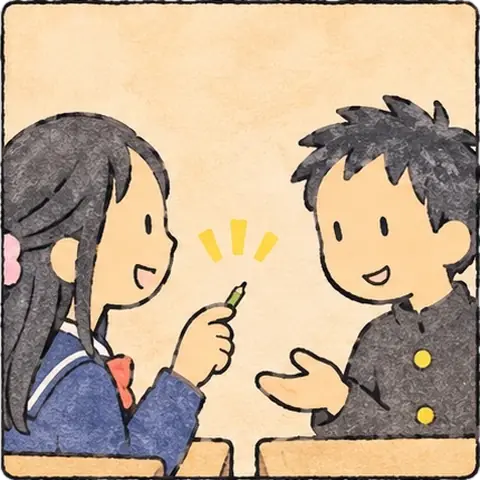
Test day: Ken has forgotten his pencils. Yui lends him one, a tiny one… with something written on it.
- ~4 minutes
- 16 sentences
- 290 characters
- 5 kanji
- 1 N4 word
Every word and every kanji is checked against the N5 lists; 1 word from N4, flagged in the vocabulary. How we check →
The story
今日は えいごの テストです。
Today is the English test.
テストの 前に、けんは かばんを あけます。
Before the test, Ken opens his bag.
えんぴつが ありません!
No pencils!
「えんぴつを いえに わすれた……」
"I left my pencils at home…"
Rōmaji of this paragraph
Kyou wa eigo no tesuto desu. Tesuto no mae ni, Ken wa kaban o akemasu. Enpitsu ga arimasen! “Enpitsu o ie ni wasureta…”
となりの ゆいが、けんに とても みじかい えんぴつを かします。
Yui, who sits next to him, lends Ken a very short pencil.
「つぎは、わすれない ほうが いいよ」
"Next time, you'd better not forget."
Rōmaji of this paragraph
Tonari no Yui ga, Ken ni totemo mijikai enpitsu o kashimasu. “Tsugi wa, wasurenai hou ga ii yo”
テストの とき、けんは えんぴつを 見ます。
During the test, Ken looks at the pencil.
えんぴつに ことばが あります。
There's a message on the pencil.
「がんばって ください」
"Do your best!"
けんは げんきに なります。
Ken cheers up.
Rōmaji of this paragraph
Tesuto no toki, Ken wa enpitsu o mimasu. Enpitsu ni kotoba ga arimasu. “Ganbatte kudasai” Ken wa genki ni narimasu.
テストが おわってから、けんは ゆいに えんぴつを かえします。
After the test, Ken gives the pencil back to Yui.
そして、つぎの あさ、あたらしい 長い えんぴつも わたします。
And the next morning, he also hands her a new, long pencil.
長い えんぴつにも、けんの ことばが あります。
There's a message from Ken on the long pencil, too.
「ありがとう。つぎは わすれないよ」
"Thank you. Next time, I won't forget."
Rōmaji of this paragraph
Tesuto ga owatte kara, Ken wa Yui ni enpitsu o kaeshimasu. Soshite, tsugi no asa, atarashii nagai enpitsu mo watashimasu. Nagai enpitsu ni mo, Ken no kotoba ga arimasu. “Arigatou. Tsugi wa wasurenai yo”
ゆいは その えんぴつを まだ つかっていません。
Yui still hasn't used that pencil.
その えんぴつは、今も 長いです。
It is still just as long.
Rōmaji of this paragraph
Yui wa sono enpitsu o mada tsukatteimasen. Sono enpitsu wa, ima mo nagai desu.
Did you understand?
-
1 けんは えんぴつを どこに わすれましたか。
Where did Ken leave his pencils?
See the answer
Answer: 1. けんの いえ at his home
-
2 みじかい えんぴつには、どんな ことばが ありますか。
What is written on the short pencil?
See the answer
Answer: 1. がんばって ください "Do your best!"
-
3 ゆいは あたらしい 長い えんぴつを つかっていますか。
Does Yui use the new long pencil?
See the answer
Answer: 4. いいえ、まだ つかっていません。 No, not yet.

Next story
 小さな友だち
A Little Friend
Hinoko loves books. One day, someone is waiting at her door.
Tappable words, synthetic voice and review.
Grammar in this story
-
〜まえに "Before": dictionary form + まえに, even about the past; noun + の + まえに.
テストの 前に、けんは かばんを あけます。
Before the test, Ken opens his bag.
-
〜とき "When, at the time": a plain-form clause or noun + の, then とき.
テストの とき、けんは えんぴつを 見ます。
During the test, Ken looks at the pencil.
-
〜てから Te-form + から: "after doing A, B", stressing the order.
テストが おわってから、けんは ゆいに えんぴつを かえします。
After the test, Ken gives the pencil back to Yui.
-
〜ほうがいい Ta-form + ほうがいい: advice, "you had better"; negative: ないほうがいい.
「つぎは、わすれない ほうが いいよ」
"Next time, you'd better not forget."
Vocabulary 34 words
- 今日 きょう
- today
- えいご
- English (the language)
- テスト
- test, quiz
- 前 まえ
- front; before (入る 前に = "before going in")
- かばん
- bag, school bag
- あける
- to open
- えんぴつ
- pencil
- ある
- there is, to be (for things)
- いえ
- house, home
- わすれる
- to forget
- となり
- next to, next door
- とても
- very
- みじかい
- short
- かす
- to lend
- つぎ
- next; つぎの あさ = "the next morning"
- いい
- good, fine
- とき
- time; 〜とき = "when…"
- 見る みる
- to look, to see
- ことば
- word, words; a short message
- がんばる N4
- to do your best, to hang in there
- げんき
- healthy, lively
- なる
- to become
- おわる
- to end, to be over
- かえす
- to give back, to return
- そして
- and then
- あさ
- morning
- あたらしい
- new
- 長い ながい
- long
- わたす
- to hand (over)
- ありがとう
- thank you
- その
- that (already mentioned, or near the listener)
- まだ
- still; (with a negative) not yet
- つかう
- to use
- 今 いま
- now