hinoko
How hinoko works
hinoko teaches you to read Japanese with short stories, each written for one JLPT level from N5 to N2. Read the stories up to your level and you will have met every word of its vocabulary list, apart from a few left out on purpose, and 100% of hinoko’s grammar list for that level.
Who hinoko is for
- For
- Learners who know kana and want to start reading: short Japanese stories written for each JLPT level, from N5 to N2.
- How
- Tap a word to understand it, keep the ones you don’t know, and review them at the right time.
- Free
- 50 stories free on the web, without an account.
- Languages
- Fully translated into 8 languages: English, French, German, Italian, Spanish, Portuguese, Indonesian and Vietnamese. The iPhone app is not in Vietnamese yet.
- Not for
- Conversation practice, JLPT N1, or the very first steps before kana.
-
 99.5%
715 of the 718 words of the list
all 97 grammar points · in the 50 N5 stories
-
 100%
all 165 grammar points · in the 98 stories from N5 to N4
-
 99.6%
2,132 of the 2,140 words of the list
all 251 grammar points · in the 189 stories from N5 to N3
-
 99.8%
1,902 of the 1,905 words of the list
all 201 grammar points · in the 279 stories from N5 to N2
Words: Jonathan Waller’s JLPT lists, the usual reference since the JLPT stopped publishing its own. Grammar: hinoko’s list for each level, built from JLPT Sensei, jepang.org and Bunpro (there is no official one either). Words and grammar are counted in the stories and their questions. 50 of these 279 stories are free. From N5 to N2, 14 of the 5,431 words are left out on purpose: our stories don’t talk about alcoholic drinks, tobacco or suicide (these words are still on the JLPT lists). See the list
Step by step
Screens from the iPhone app: the website and the Android app work the same way.
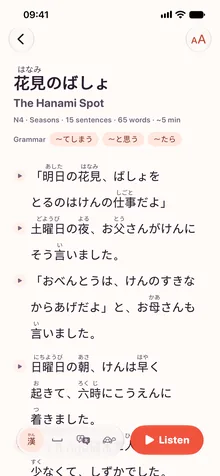
Read a story at your level
Choose N5, N4, N3 or N2: each story is written for one level. Furigana sit above every kanji (hide them whenever you like), the translation of each sentence is one tap away, and a synthesized voice reads the story at normal or slow speed, if your device has a Japanese voice.
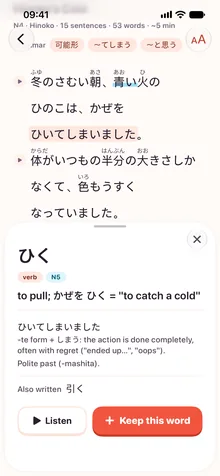
Tap a word
You see its reading, its meaning in your language and, for a conjugated form, how it is built (here ひいてしまいました). Keep the words you don’t know yet.
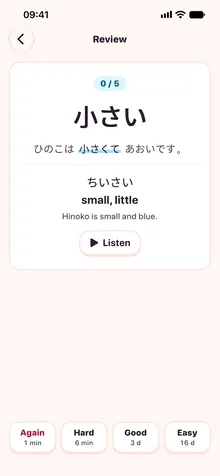
Review at the right time
The words you keep come back just before you’d forget them, in the sentence where you met them (FSRS spaced repetition). You can also export them to Anki.
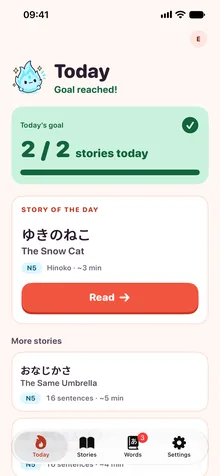
A little every day
Set a daily goal: the Today screen suggests your next story and counts your days in a row (on the website and in the Android app, with a free account). That account also keeps your progress on the web, iPhone and Android.
How a story is made for one level

Each level has a plan: the words and grammar points its stories must use, so that, with the stories of the levels below, they cover the whole list of the level. A story uses only the words, kanji and grammar of its level and the levels below, plus a few exceptions capped by the script and flagged in their card.
Before a story is published, a script reads every sentence and checks it against the lists of its level. A story goes online only once the script finds no blocking problem.
- The planthe words and grammar the level still needs
- The storywritten for one level
- The checkskanji, words, readings, grammar, translations, questions
- The fixeswhatever fails is rewritten, then checked again
- Onlinein 8 languages, with its word cards and 3 questions
What is checked, and what is not yet
| What | Checked before publication? | How |
|---|---|---|
| Kanji | Yes | Every kanji shown is on the kanji list of the level or of a lower level; other words are written in kana. |
| Words | Yes | Every word is on the list of the level or of a lower level (Jonathan Waller’s JLPT lists, completed by the Japan Foundation’s Irodori and Marugoto courses for everyday words). The script allows a few exceptions per story, and caps them: words from the next level up or outside the lists (such as もも in Momotarō), flagged in their card and, from N3, up to 3 compounds made of words of the level. |
| Readings | Yes | A Japanese text analyzer, MeCab with UniDic, reads every sentence again: its reading must match the furigana. The reading of each word is also compared with JMdict. |
| Grammar | Yes | Each sentence lists the grammar points it uses, and the script checks that each one is on the grammar list of the level or of a lower level (built from JLPT Sensei, jepang.org and Bunpro). It also refuses verb forms, grammar words and some constructions above the level. |
| Translations | Yes | Every sentence and every word card exists in the 8 languages; a script checks that none is missing and that names and Japanese words are kept. |
| Questions | Yes | Every story has 3 questions, each with 4 choices and its answer. |
| Wording of the translations | Not yet | The script checks that a translation exists and keeps the names and the Japanese, not that it is the most natural one. |
| Audio | Not yet | The audio is the synthesized Japanese voice of your device: hinoko does not check what it reads. When the voice and the furigana disagree, trust the furigana. |
The 14 words left out on purpose
Our stories don’t talk about alcoholic drinks, tobacco or suicide, so no story uses these words of the JLPT lists. They are the only ones missing, and they are still on the JLPT.
| Why | Words |
|---|---|
| Alcohol |
|
| Tobacco |
|
| Suicide |
|
The limits
- There is no official list of words, kanji or grammar: the JLPT stopped publishing its lists in 2010. hinoko’s word levels follow Jonathan Waller’s lists, the usual reference; its kanji and grammar levels follow the sources in the credits. None of them is the exam itself.
- Reading every story of a level does not guarantee that you will pass the JLPT, which also tests listening.
- The voice is synthesized: it is the Japanese voice of your phone, computer or browser, not a recording.
- A graded story is simpler than a novel or a newspaper, on purpose: its words stay within the level.
- No N1 yet: the stories go from N5 to N2.
Free, Premium and independent
50 stories are free, with no account and no ads: 15 at N5, 11 at N4, 14 at N3, and 10 at N2, folktales included. In every story you can open, the furigana, translations, audio, word cards, questions, reviews and Anki export are free, and a free account keeps your progress on all your devices.
hinoko Premium opens all 279 stories and every new one: €3.99 a month, €29.99 a year (with 7 days free) or €79.99 once. In the iPhone app, App Store prices are set for each country and may differ.
Discover hinoko Premium →No ads, no selling of your data, no tracking from one site or app to another. Privacy
hinoko is independent: it is not affiliated with or endorsed by the Japan Foundation or Japan Educational Exchanges and Services (JEES), which run the JLPT. The levels N5 to N2 only say which level a story is written for.
How does hinoko compare with other apps? Japanese reading apps compared: levels, free reading, voice and JLPT tests
Who makes hinoko
hinoko is made by Hugo Bonnet, an independent developer in France (sole proprietor). Legal notice
Credits and sources
The lists, dictionaries and tools hinoko relies on to set the level of each story, check it and display it.
| Source | What hinoko uses it for |
|---|---|
| Jonathan Waller’s JLPT lists (tanos.co.uk) | The vocabulary list of each level, from N5 to N1: the level of every word, and the coverage figures. The files come from the open-anki-jlpt-decks project. |
| JMdict (EDRDG) | The reading of each word is compared with its JMdict entry, through Jisho.org, when a story is checked. JMdict is the property of the Electronic Dictionary Research and Development Group (EDRDG) and is available under the Group’s licence, Creative Commons Attribution-ShareAlike 4.0 (CC BY-SA 4.0). |
| MeCab and UniDic | The Japanese text analyzer that reads every sentence again, run through fugashi. MeCab (Taku Kudo), UniDic 2.1.2 (UniDic Consortium) and fugashi are free software: BSD licence for MeCab and UniDic, MIT for fugashi. |
| JLPT Sensei, jepang.org and Bunpro | Their grammar lists by level: hinoko’s grammar list for each level is built from these three, with a fixed rule when they disagree. |
| Irodori and Marugoto (Japan Foundation) | The vocabulary lists of these two courses, to place at a level the everyday words that the JLPT lists lack, such as コンビニ or スマホ. |
| Genki I (The Japan Times) | The greetings of its lesson 0, such as いただきます or ただいま, counted as N5. |
| kanjiapi.dev, JLPT Sensei and Kanshudo | The kanji of each level: a kanji belongs to a level when two of these three sources place it there. |
| jlpt.jp | The official JLPT website: the format of the reading section, for the reading tests of the level pages. |
| FSRS | The spaced repetition algorithm that schedules your reviews (FSRS-5, with its default parameters), from the open-spaced-repetition project. |
| Nunito | The typeface of the website, by The Nunito Project Authors, under the SIL Open Font License 1.1. Japanese is shown in your device’s fonts. |
Found a mistake?
Write to contact@hinoko-japanese.com with the title of the story and the sentence: every report is checked, and every mistake is fixed. We answer in English or French.