 hinoko
JLPT N4 reading practice: a test and stories to go further

48 stories · 11 free · about 7 min each
N4 builds on N5: 247 kanji (the 80 of N5 and 167 more) and the grammar of everyday stories, such as the potential and passive forms, たら and ば, てしまう, giving and receiving. These 48 stories use N5 and N4 words, with at most 2 N3 words in a story, flagged in their card.
JLPT N4 reading practice test

3 questions in the format of the reading part of the exam (読解, dokkai), on texts written for this page. Pick an answer and the explanation appears.
Text 1
田中さんの つくえの 上に、この メモが あります。
田中さん
午後 二時ごろ、
山本
Show the translation
This note is on Tanaka-san's desk.
Tanaka-san,
Around 2 p.m., Kinoshita-san from ABC Travel called. Kinoshita-san would like to move next week's meeting from 10:00 to 11:00. Please call Kinoshita-san back before the end of today. I'm going out from three o'clock, so I'm counting on you.
Yamamoto
-
1この メモを 読んで、
田中さんは 何を しなければ なりませんか。 See the answer
Answer: 4. Yamamoto asks Tanaka to call Kinoshita back today (今日中に 木下さんに 電話を して ください); 今日の うちに means the same thing. Moving the meeting to 11:00 is Kinoshita's request, not a task for Tanaka yet.
Text 2
これは 学生が 書いた 作文です。
わたしの 町には、
図書館の 二かいには しずかに 勉強できる へやが あって、
先週、
こんどは、
Show the translation
An essay written by a student.
There is a big library in my town. I go there every Saturday.
On the second floor there is a room where you can study quietly, and it is always full of students. I like the seat by the window on the third floor. From there you can see the town park, and on sunny days it feels wonderful.
Last week I found an old cookbook at the library. The book was fifty years old and had not a single photo, but the recipes were written very carefully. When I got home, I tried making a fish soup exactly as the book said. It took a little time, but my mother told me it was better than the soup at a restaurant.
Next time, I'd like to try making sweets from that book.
-
2「わたし」が 三がいの まどの 近くの せきが すきなのは どうしてですか。
See the answer
Answer: 1. そこからは 町の こうえんが 見えて: from that seat you can see the park, which makes sunny days pleasant. The quiet study room full of students is on another floor (二かい).
-
3「わたし」は 先週、
何を しましたか。 See the answer
Answer: 2. Back home, the writer made fish soup following the old book (その 本の とおりに). The book was found at the library, not used to cook there, and the sweets are only a plan (作って みたい).

The 48 N4 stories
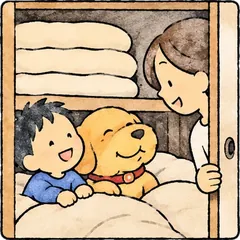
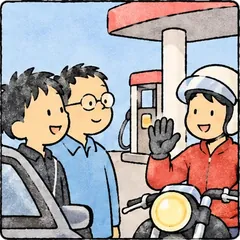
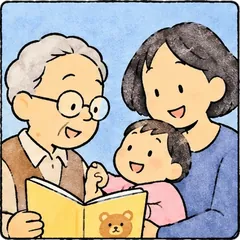
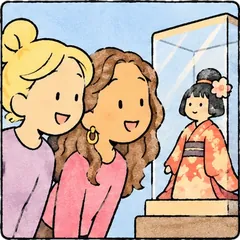
Furigana stays above every kanji until you hide it, and each sentence has its translation one tap away. Read the story once for the gist, then a second time for the details.





きせつSeasons
0/2

ひのこHinoko
0/2


37 more N4 stories with Premium
















Grammar in these stories
The grammar points these stories use most, each linked to its explanation in our JLPT grammar lists, often with an example.
- 〜てしまう Te-form + しまう: do something completely, or with regret (by mistake); spoken: 〜ちゃう.
- 受身形 Passive form: "be done by someone" (doer + に), also for unwelcome events.
- 〜てくれる Te-form + くれる: someone does something for me or my side.
- 〜ながら Stem + ながら: doing two things at once, "while…", by the same person.
- 可能形 Potential form, "can, be able to" (書ける, 食べられる); the object often takes が.
- 〜たら Ta-form + ら: "if", or "when, once" A has happened, then B.
- 〜てほしい Te-form + ほしい: "I want (someone) to do…" (the person + に).
- 使役形 Causative form: "make or let someone do" (行かせる, 食べさせる).
- 〜と(条件) Dictionary form + と: "when A, (always) B", a natural or automatic result.
- 〜と思う Plain form + と思う: "I think that…"; と marks what is thought.
- 〜そう(様子) Verb or adjective stem + そう: "looks…", "seems about to…" (おいしそう).
- 〜てあげる Te-form + あげる: do something for someone else, as a favor.
The reading part of the N4 exam
At the exam, reading (読解, dokkai) has no time of its own: it shares the 55 minutes of the section “Language knowledge (grammar) and reading” with the grammar questions. It has about 8 questions of three kinds, each with four choices:
| Kind of question | What you read | Length | Questions |
|---|---|---|---|
| 内容理解(短文)Comprehension (short passages)Text 1 of the test above | A short text on study, daily life or work, such as a note or an email. | 100 to 200 characters | 3 |
| 内容理解(中文)Comprehension (mid-size passages)Text 2 of the test above | A simple everyday text, often a short personal account. | about 450 characters | 3 |
| 情報検索Information retrieval | A notice or an information sheet: find what you need in it. | about 400 characters | 2 |
Lengths: approximate number of Japanese characters, as set by the JLPT for each kind of text. Questions: indicative numbers since December 2020, which can vary slightly from one session to another. Sources on jlpt.jp: test times, number of questions (notice of September 2020), length of the texts (in Japanese).
- Official sample questions (jlpt.jp) ↗
Free, from the organizers of the JLPT.
- JLPT N4: test format, question types and pass mark
Every section of the exam, its time and the pass mark.
How many kanji and words for N4?

In our lists, N4 adds 668 new words and 167 kanji to those of N5, for about 1,386 words and 247 kanji in all, plus 165 grammar points. The JLPT has published no official list of words or kanji since 2010: these figures are based on the lists compiled by Jonathan Waller, which many learners use.
 718 words in all +718 new words 97 grammar points 50 stories
 This page 1,386 words in all +668 new words 165 grammar points 48 stories
 3,526 words in all +2,140 new words 251 grammar points 91 stories
 5,329 words in all +1,803 new words 201 grammar points 90 stories
Together, our 98 stories from N5 to N4 use 668 of the 668 words of the JLPT N4 vocabulary list and its 165 grammar points: read them all and you have met the level in context.
Learn them by reading rather than by heart: in the stories, the most useful words come back again and again, in context. The lists below are there to check what is left; 105 of the 668 words of the vocabulary list link to a free story where they appear.
Reading without rōmaji, and when to hide the furigana
Kana, not rōmaji
Like the exam, the N4 test and stories have no rōmaji. When a reading stops you, look at its furigana instead of looking for rōmaji: that is how readings stick.
When to hide the furigana
Read a story once with furigana, then hide them for the second reading and show them only for the word that stops you. At the exam, the kanji reading questions use N5 and N4 kanji with no furigana.
Is N4 the right level for you?
N4 is your level if:
- you can read N5 stories without the translation;
- you know the te form and the plain form of verbs;
- forms such as 読める, 読まれる, 読んだら and 読めば are new or still shaky;
- the N4 test above is within reach, with the furigana on.
Questions about reading at N4
How long is the reading part of the JLPT N4?
Reading has no time of its own: it shares the 55 minutes of the section “Language knowledge (grammar) and reading” with the grammar questions.
What kinds of texts are in the JLPT N4 reading part?
Three kinds of questions, each with four choices: short texts (100 to 200 characters), mid-size texts (about 450 characters), and a document to search for information (about 400 characters).
How many reading questions are there in the JLPT N4?
About 8 questions: 3 on short texts, 3 on mid-size texts, and 2 on a document to search for information. These are the JLPT’s indicative numbers since December 2020; a session can differ slightly.
Are the texts on this page real JLPT questions?
No: the test and the stories are original texts, written for N4. The questions follow the format of the exam, and the official sample questions are free on jlpt.jp.
Can I practice JLPT N4 reading for free?
Yes: the test at the top of this page and 11 of the 48 N4 stories are free to read online, without an account.
How long does it take to read an N4 story?
About 7 minutes on average, for a story of about 16 sentences.
Didn’t find your answer?
Write to us at contact@hinoko-japanese.com: we answer in English or French.