 hinoko
JLPT N5 reading practice: a test and stories for beginners

50 stories · 15 free · about 5 min each
N5 is the first level of the JLPT: kana, the first kanji and everyday words. These 50 stories use N5 words and no kanji beyond the 80 of N5, all with furigana; the few N4 words or forms (at most 4 in a story) are flagged in their card.
JLPT N5 reading practice test

3 questions in the format of the reading part of the exam (読解, dokkai), on texts written for this page. Pick an answer and the explanation appears.
Text 1
マリアさんから ゆうこさんへの メモです。
ゆうこさんへ
あしたの パーティーは 六時からです。
わたしは 五時に えきの 前で まって います。
ケーキは わたしが かいます。
マリア
Show the rōmaji
Maria-san kara Yūko-san e no memo desu.
Yūko-san e
Ashita no pātī wa roku-ji kara desu.
Watashi wa go-ji ni eki no mae de matte imasu. Issho ni ikimashō.
Kēki wa watashi ga kaimasu. Yūko-san wa nomimono o katte kite kudasai.
Maria
Show the translation
A note from Maria to Yuko.
Yuko,
Tomorrow's party starts at six.
I'll be waiting in front of the station at five. Let's go together.
I'll buy the cake. Could you buy some drinks and bring them?
Maria
-
1ゆうこさんは あした 何を しますか。
See the answer
Answer: 3. Maria buys the cake herself and asks Yuko to buy drinks and bring them (のみものを かって きて ください). They meet in front of the station at five, an hour before the party.
Text 2
リーさんが 書いた さくぶんです。
わたしは 先月、
きのうは 日よう日でした。
ひるごはんは 山下さんの へやで 食べました。
午後は 一人で 本やへ 行って、
Show the rōmaji
Rī-san ga kaita sakubun desu.
Watashi wa sengetsu, Nihon ni kimashita. Ima wa daigaku no chikaku no apāto ni sunde imasu.
Kinō wa nichiyōbi deshita. Asa, tonari no heya no Yamashita-san to kawa no soba o sanpo shimashita. Kawa no mizu wa totemo kirei deshita.
Hirugohan wa Yamashita-san no heya de tabemashita. Yamashita-san ga karē o tsukurimashita. Sukoshi karakatta desu ga, oishikatta desu.
Gogo wa hitori de hon'ya e itte, Nihongo no hon o ni-satsu kaimashita. Konban kara mainichi sukoshi zutsu yomimasu.
Show the translation
An essay by Li.
I came to Japan last month. I now live in an apartment near the university.
Yesterday was Sunday. In the morning I took a walk by the river with Yamashita-san from the room next door. The river water was very clean.
We had lunch in Yamashita-san's room. Yamashita-san made curry. It was a little spicy, but it was good.
In the afternoon I went to the bookstore alone and bought two books in Japanese. Starting tonight, I'll read a little every day.
-
2リーさんは きのうの 午後、
何を しましたか。 See the answer
Answer: 1. In the afternoon (午後), Li went to the bookstore alone (一人で) and bought two books. The walk was in the morning, lunch was at Yamashita's, and the reading only starts tonight.
-
3山下さんの カレーは どうでしたか。
See the answer
Answer: 4. すこし からかったですが、おいしかったです: a little spicy, but good. Li ate it with Yamashita, so option 2 is wrong.

Download the free PDF: N5 stories with questions and answers
The 50 N5 stories
Start with the first story and read one sentence at a time. Tap a word you don’t know to see its reading, meaning and form, keep it, and it comes back for review just before you’d forget it.



電車と まちTrains and town
0/2

うちでAt home
0/2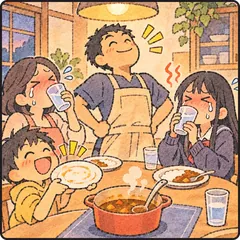
休みDays off
0/2

ひのこHinoko
0/3


35 more N5 stories with Premium
















Grammar in these stories
The grammar points these stories use most, each linked to its explanation in our JLPT grammar lists, often with an example.
- 〜ている Te-form + いる: an action in progress, or a resulting state (結婚している).
- 普通形(会話) Casual speech: plain forms (行く, 行かない, 行った) instead of です and ます.
- 〜とき "When, at the time": a plain-form clause or noun + の, then とき.
- 〜たことがある Ta-form + ことがある: "have done before", a past experience.
- 〜て(つなぐ) Te-form joining actions in sequence: "do A, and then B".
- から "From" a place, time or person; after a clause, "because".
- 〜く なる i-adjective い → く + なる: "become…" (大きくなる, "get bigger").
- 〜んです Plain form + んです: explaining, or asking for an explanation, "the thing is…".
- 〜てもいいですか Te-form + もいい: permission, "you may"; with ですか, "may I…?"
- 〜ましょう Polite "let’s…": suggests doing something together (行きましょう).
- 〜まえに "Before": dictionary form + まえに, even about the past; noun + の + まえに.
- 〜つもり Dictionary or ない form + つもりです: "I intend to (not) do".
The reading part of the N5 exam
At the exam, reading (読解, dokkai) has no time of its own: it shares the 40 minutes of the section “Language knowledge (grammar) and reading” with the grammar questions. It has about 5 questions of three kinds, each with four choices:
| Kind of question | What you read | Length | Questions |
|---|---|---|---|
| 内容理解(短文)Comprehension (short passages)Text 1 of the test above | A short text on study, daily life or work, such as a note or an email. | about 80 characters | 2 |
| 内容理解(中文)Comprehension (mid-size passages)Text 2 of the test above | A simple everyday text, often a short personal account. | about 250 characters | 2 |
| 情報検索Information retrieval | A notice or an information sheet: find what you need in it. | about 250 characters | 1 |
Lengths: approximate number of Japanese characters, as set by the JLPT for each kind of text. Questions: indicative numbers since December 2020, which can vary slightly from one session to another. Sources on jlpt.jp: test times, number of questions (notice of September 2020), length of the texts (in Japanese).
- Official sample questions (jlpt.jp) ↗
Free, from the organizers of the JLPT.
- JLPT N5: test format, question types and pass mark
Every section of the exam, its time and the pass mark.
How many kanji and words for N5?

In our lists, N5 is 718 words, 80 kanji and 97 grammar points: everyday words, the most common kanji such as 日, 月, 人 and 山, the particles and the polite forms of verbs. The JLPT has published no official list of words or kanji since 2010: these figures are based on the lists compiled by Jonathan Waller, which many learners use.
 This page 718 words in all +718 new words 97 grammar points 50 stories
 1,386 words in all +668 new words 165 grammar points 48 stories
 3,526 words in all +2,140 new words 251 grammar points 91 stories
 5,329 words in all +1,803 new words 201 grammar points 90 stories
Together, these 50 stories use 715 of the 718 words of the JLPT N5 vocabulary list (the 3 others are not in our stories, which don’t talk about alcoholic drinks, tobacco or suicide, and are still on the JLPT list) and its 97 grammar points: read them all and you have met the level in context.
Learn them by reading rather than by heart: in the stories, the most useful words come back again and again, in context. The lists below are there to check what is left; 234 of the 718 words of the vocabulary list link to a free story where they appear.
Reading without rōmaji, and when to hide the furigana
Kana, not rōmaji
The JLPT is written in kana and kanji only, with no rōmaji. If hiragana and katakana still slow you down, practice them first: reading in rōmaji would only put off that step. In the test above, the rōmaji is just there to check yourself.
When to hide the furigana
Keep them while you learn the 80 N5 kanji. Then read a story you know with the furigana hidden: the kanji you can still read are the ones you know. At the exam, the vocabulary part asks you to read N5 words written in kanji without any help.
Is N5 the right level for you?
N5 is your level if:
- you can read hiragana and katakana, even slowly;
- short sentences with です and ます and the particles は, を, に and で make sense to you;
- you know a few kanji such as 日, 人 and 水, or you are learning them;
- the test above is within reach, even with a look at the translation.
Questions about reading at N5
How long is the reading part of the JLPT N5?
Reading has no time of its own: it shares the 40 minutes of the section “Language knowledge (grammar) and reading” with the grammar questions.
What kinds of texts are in the JLPT N5 reading part?
Three kinds of questions, each with four choices: short texts (about 80 characters), mid-size texts (about 250 characters), and a document to search for information (about 250 characters).
How many reading questions are there in the JLPT N5?
About 5 questions: 2 on short texts, 2 on mid-size texts, and 1 on a document to search for information. These are the JLPT’s indicative numbers since December 2020; a session can differ slightly.
Are the texts on this page real JLPT questions?
No: the test and the stories are original texts, written for N5. The questions follow the format of the exam, and the official sample questions are free on jlpt.jp.
Can I practice JLPT N5 reading for free?
Yes: the test at the top of this page and 15 of the 50 N5 stories are free to read online, without an account. A free PDF of N5 stories with questions is also there to print.
How long does it take to read an N5 story?
About 5 minutes on average, for a story of about 17 sentences.
Didn’t find your answer?
Write to us at contact@hinoko-japanese.com: we answer in English or French.