 hinoko
ポチはどこ? Where's Pochi?
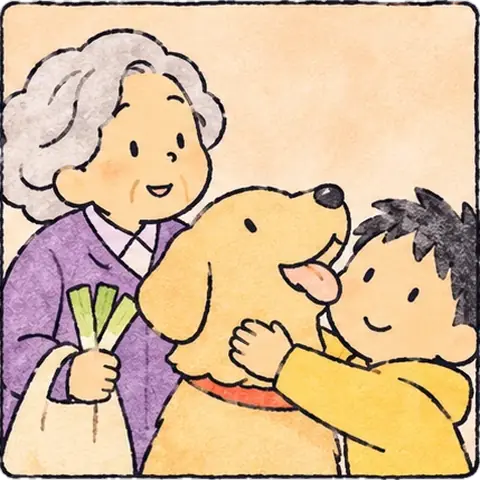
Pochi, the family dog, has disappeared. The whole family searches everywhere…
- ~4 minutes
- 14 sentences
- 254 characters
- 9 kanji
- 2 N4 words
Every word and every kanji is checked against the N5 lists; 2 words from N4, flagged in the vocabulary. How we check →
The story
「ポチ!ポチ!」
"Pochi! Pochi!"
ゆいが にわで いぬの ポチを よんでいます。
Yui is calling Pochi the dog in the garden.
でも、ポチが いません。
But Pochi isn't there.
Rōmaji of this paragraph
“Pochi! Pochi!” Yui ga niwa de inu no Pochi o yondeimasu. Demo, Pochi ga imasen.
お父さんと お母さんも 来て、みんなで さがします。
Dad and Mom come too, and they all search together.
いっしょに すんでいる おばあさんは かいものに 行っています。
Grandma, who lives with them, is out shopping.
お父さんは こうえんへ 行って、そらは ベッドの 下を 見ています。
Dad goes to the park, and Sora looks under the bed.
お母さんが いいます。
Mom says:
「そら、ポチは 大きいから、そこには いないよ」
"Sora, Pochi is big, so he isn't under there."
そらは ないています。
Sora is crying.
Rōmaji of this paragraph
Otousan to okaasan mo kite, minnade sagashimasu. Isshoni sundeiru obaasan wa kaimono ni itteimasu. Otousan wa kouen e itte, Sora wa beddo no shita o miteimasu. Okaasan ga iimasu. “Sora, Pochi wa ookii kara, soko ni wa inai yo” Sora wa naiteimasu.
ゆうがた、おばあさんが かいものから かえります。
In the late afternoon, Grandma comes back from shopping.
「ただいま」
"I'm home!"
おばあさんの 後ろに、ポチが います!
Behind Grandma, there's Pochi!
「ポチは スーパーまで いっしょに 来て、みせの 前で まっていたよ」
"Pochi came with me all the way to the supermarket, and he waited in front of the store."
Rōmaji of this paragraph
Yuugata, obaasan ga kaimono kara kaerimasu. “Tadaima” Obaasan no ushiro ni, Pochi ga imasu! “Pochi wa suupaa made isshoni kite, mise no mae de matteita yo”
その ばん、そらは ポチの そばで ねます。
That night, Sora sleeps next to Pochi.
Rōmaji of this paragraph
Sono ban, Sora wa Pochi no soba de nemasu.
Did you understand?
-
1 お父さんは どこへ 行きますか。
Where does Dad go?
See the answer
Answer: 2. こうえん to the park
-
2 ゆうがた、だれが かいものから かえりますか。
In the late afternoon, who comes back from shopping?
See the answer
Answer: 4. おばあさん Grandma
-
3 ポチは どこで まっていましたか。
Where was Pochi waiting?
See the answer
Answer: 1. スーパーの 前 in front of the supermarket

Next story
 えいがかんで
At the Movies
Ken and Emma go to the movie theater to see a scary movie.
Tappable words, synthetic voice and review.
Grammar in this story
-
〜ている Te-form + いる: an action in progress, or a resulting state (結婚している).
ゆいが にわで いぬの ポチを よんでいます。
Yui is calling Pochi the dog in the garden.
-
〜て(つなぐ) Te-form joining actions in sequence: "do A, and then B".
お父さんと お母さんも 来て、みんなで さがします。
Dad and Mom come too, and they all search together.
-
から "From" a place, time or person; after a clause, "because".
「そら、ポチは 大きいから、そこには いないよ」
"Sora, Pochi is big, so he isn't under there."
-
〜に行く Verb stem or action noun + に行く: go somewhere in order to do it.
いっしょに すんでいる おばあさんは かいものに 行っています。
Grandma, who lives with them, is out shopping.
Vocabulary 36 words
- どこ
- where
- にわ
- garden, yard
- いぬ
- dog
- よぶ
- to call (someone)
- でも
- but
- いる
- to be, to exist (living things)
- お父さん おとうさん
- father, dad (someone else's, or to call your own)
- お母さん おかあさん
- mother; "mom" (children also call their own mother this)
- 来る くる
- to come
- みんなで
- all together
- さがす N4
- to look for, to search
- いっしょに
- together
- すむ
- to live (somewhere)
- おばあさん
- old woman; grandmother
- かいもの
- shopping
- 行く いく
- to go
- こうえん
- park
- ベッド
- bed
- 下 した
- under, below
- 見る みる
- to look, to see
- いう
- to say
- 大きい おおきい
- big
- そこ
- there, that place
- なく N4
- to cry
- ゆうがた
- late afternoon, early evening
- かえる
- to go home, to return
- ただいま
- "I'm home!"
- 後ろ うしろ
- behind
- スーパー
- supermarket
- みせ
- shop, store; restaurant
- 前 まえ
- front; before (入る 前に = "before going in")
- まつ
- to wait
- その
- that (already mentioned, or near the listener)
- ばん
- evening
- そば
- beside, near
- ねる
- to sleep, to go to bed