 hinoko
マリアのえ Maria's Drawing
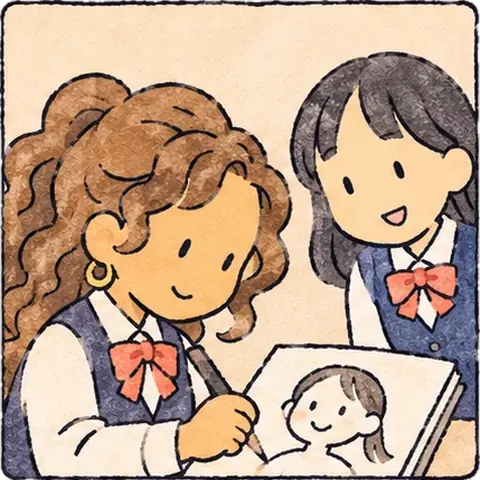
Maria, the new student, barely speaks and eats lunch alone. One day in English class, the teacher stops at her desk…
- ~4 minutes
- 14 sentences
- 302 characters
- 9 kanji
- 0 N4 words
Every word and every kanji is checked against the N5 lists; no word from a higher level. How we check →
The story
ゆいの クラスに、あたらしい せいとが 来ました。
A new student came to Yui's class.
「マリアです。ブラジルから 来ました。よろしく おねがいします」
"I'm Maria. I'm from Brazil. Nice to meet you."
Rōmaji of this paragraph
Yui no kurasu ni, atarashii seito ga kimashita. “Maria desu. Burajiru kara kimashita. Yoroshiku onegaishimasu”
マリアは しずかで、あまり 話しませんでした。
Maria was quiet and didn't talk much.
ひるごはんも いつも 一人で 食べていました。
And at lunch, she always ate alone.
Rōmaji of this paragraph
Maria wa shizukade, amari hanashimasen deshita. Hirugohan mo itsumo hitori de tabeteimashita.
えいごの じゅぎょうで、マリアは ノートに えを かいていました。
In English class, Maria was drawing in her notebook.
先生が マリアの つくえの 前で とまりました。
The teacher stopped in front of Maria's desk.
ノートには、先生の かおの えが ありました。
In the notebook, there was a drawing of the teacher's face.
クラスの みんなが 先生を 見ていました。
The whole class was watching the teacher.
Rōmaji of this paragraph
Eigo no jugyou de, Maria wa nooto ni e o kaiteimashita. Sensei ga Maria no tsukue no mae de tomarimashita. Nooto ni wa, sensei no kao no e ga arimashita. Kurasu no minna ga sensei o miteimashita.
「これは わたしですか」
"Is this me?"
「はい……すみません」
"Yes… I'm sorry."
先生は えを よく 見て、いいました。
The teacher looked closely at the drawing and said:
「とても じょうずですね!クラスの みんなの かおも かきませんか」
"You draw very well! Why don't you draw everyone's faces, too?"
Rōmaji of this paragraph
“Kore wa watashi desu ka” “Hai… sumimasen” Sensei wa e o yoku mite, iimashita. “Totemo jouzu desu ne! Kurasu no minna no kao mo kakimasenka”
その ひるやすみ、マリアの つくえの 前に、みんなが ならんでいました。
At lunch that day, everyone was lining up in front of Maria's desk.
マリアの ひるごはんは、とても にぎやかでした。
Maria's lunch was very lively.
Rōmaji of this paragraph
Sono hiruyasumi, Maria no tsukue no mae ni, minna ga narandeimashita. Maria no hirugohan wa, totemo nigiyaka deshita.
Did you understand?
-
1 マリアは どこから 来ましたか。
Where does Maria come from?
See the answer
Answer: 3. ブラジル from Brazil
-
2 マリアは ノートに 何を かいていましたか。
What was Maria drawing in her notebook?
See the answer
Answer: 2. 先生の かお the teacher's face
-
3 ひるやすみに、だれが マリアの つくえの 前に ならんでいましたか。
At lunch break, who was lining up in front of Maria's desk?
See the answer
Answer: 4. クラスの みんな everyone in the class

Next story
 うみへ行くバス
The Bus to the Sea
Ken doesn't like the dentist. Today he's going there by bus… but not on the right one.
Tappable words, synthetic voice and review.
Grammar in this story
-
〜て(つなぐ) Te-form joining actions in sequence: "do A, and then B".
先生は えを よく 見て、いいました。
The teacher looked closely at the drawing and said:
-
〜ている Te-form + いる: an action in progress, or a resulting state (結婚している).
ひるごはんも いつも 一人で 食べていました。
And at lunch, she always ate alone.
-
〜ませんか "Won’t you…?": a polite invitation that leaves the choice to the listener.
「とても じょうずですね!クラスの みんなの かおも かきませんか」
"You draw very well! Why don't you draw everyone's faces, too?"
Vocabulary 39 words
- クラス
- class (the students)
- あたらしい
- new
- せいと
- student, pupil
- 来る くる
- to come
- ブラジル
- Brazil
- よろしく
- with おねがいします: "nice to meet you", "please treat me well"
- おねがいします
- please
- しずか
- quiet
- あまり
- (with a negative verb) not much, not very
- 話す はなす
- to speak, to talk
- ひるごはん
- lunch
- いつも
- always
- 一人 ひとり
- one person; alone (一人で, いつも 一人)
- 食べる たべる
- to eat
- えいご
- English (the language)
- じゅぎょう
- class, lesson
- ノート
- notebook
- え
- picture, drawing
- かく
- to draw (えを かく)
- 先生 せんせい
- teacher
- つくえ
- desk
- 前 まえ
- front; before (入る 前に = "before going in")
- とまる
- to stop
- かお
- face
- ある
- there is, to be (for things)
- みんな
- everyone; all
- 見る みる
- to look, to see
- これ
- this (near me)
- わたし
- I, me
- はい
- yes
- すみません
- excuse me, sorry
- よく
- well; often
- いう
- to say
- とても
- very
- じょうず
- skilled, good at
- その
- that (already mentioned, or near the listener)
- ひるやすみ
- lunch break
- ならぶ
- to line up, to wait in line
- にぎやか
- lively, bustling
JLPT N5 vocabulary list: all 718 words →