 hinoko
えきのでぐち The Station Exit
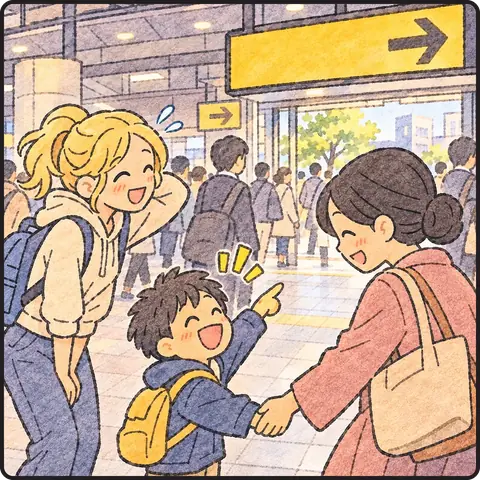
Lost in a station, Emma asks for directions… from someone who doesn't know the way either.
- ~3 minutes
- 12 sentences
- 206 characters
- 11 kanji
- 0 N4 words
Every word and every kanji is checked against the N5 lists; no word from a higher level. How we check →
The story
エマは とうきょうの 大きい えきに いました。
Emma was in a big station in Tokyo.
でぐちが たくさん ありました。
There were lots of exits.
でも、北ぐちは 分かりませんでした。
But she couldn't find the north exit.
Rōmaji of this paragraph
Ema wa toukyou no ookii eki ni imashita. Deguchi ga takusan arimashita. Demo, kitaguchi wa wakarimasen deshita.
となりに 小さい 男の子が いました。
Next to her, there was a little boy.
「すみません。北ぐちは どこですか」
"Excuse me. Where is the north exit?"
男の子は 小さい こえで いいました。
The boy said in a small voice:
「分かりません……。お母さんは 北ぐちに います」
"I don't know… My mom is at the north exit."
「じゃあ、いっしょに 行きましょう」
"Then let's go together."
Rōmaji of this paragraph
Tonari ni chiisai otokonoko ga imashita. “Sumimasen. Kitaguchi wa doko desu ka” Otokonoko wa chiisai koe de iimashita. “Wakarimasen…. Okaasan wa kitaguchi ni imasu” “Jaa, isshoni ikimashou”
東ぐち、西ぐち、南ぐち……。
The east exit, the west exit, the south exit…
そして、北ぐちに お母さんが いました。
And at the north exit, there was his mom.
Rōmaji of this paragraph
Higashiguchi, nishiguchi, minamiguchi…. Soshite, kitaguchi ni okaasan ga imashita.
男の子は 大きい こえで いいました。
The boy said in a loud voice:
「おねえさん、北ぐちは ここですよ!」
"Miss, the north exit is right here!"
Rōmaji of this paragraph
Otokonoko wa ookii koe de iimashita. “Oneesan, kitaguchi wa koko desu yo!”
Did you understand?
-
1 エマは だれに 聞きましたか。
Who did Emma ask for directions?
See the answer
Answer: 3. 小さい 男の子 a little boy
-
2 男の子の お母さんは どこに いましたか。
Where was the boy's mother?
See the answer
Answer: 1. 北ぐち at the north exit
-
3 エマは どこに いましたか。
Where was Emma?
See the answer
Answer: 4. とうきょうの 大きい えき in a big station in Tokyo

Next story
 お父さんのカレー
Dad's Curry
On Sunday evening, Dad is in the kitchen: he's making curry for the first time. The whole family sits down to eat…
Tappable words, synthetic voice and review.
Grammar in this story
-
います Polite いる: "there is, (someone) is", for people and animals.
エマは とうきょうの 大きい えきに いました。
Emma was in a big station in Tokyo.
-
あります Polite ある: "there is, I have", for objects, plants and events.
でぐちが たくさん ありました。
There were lots of exits.
-
〜ませんでした Polite past negative of 〜ます: "did not" (行きませんでした).
でも、北ぐちは 分かりませんでした。
But she couldn't find the north exit.
-
〜ましょう Polite "let’s…": suggests doing something together (行きましょう).
「じゃあ、いっしょに 行きましょう」
"Then let's go together."
Vocabulary 27 words
- とうきょう
- Tokyo
- 大きい おおきい
- big
- えき
- station
- いる
- to be, to exist (living things)
- でぐち
- exit
- たくさん
- a lot, many
- ある
- there is, to be (for things)
- でも
- but
- 北ぐち きたぐち
- north exit (of a station)
- 分かる わかる
- to understand, to know
- となり
- next to, next door
- 小さい ちいさい
- small, little
- 男の子 おとこのこ
- boy
- すみません
- excuse me, sorry
- どこ
- where
- こえ
- voice
- いう
- to say
- お母さん おかあさん
- mother; "mom" (children also call their own mother this)
- じゃあ
- well then, so
- いっしょに
- together
- 行く いく
- to go
- 東ぐち ひがしぐち
- east exit (of a station)
- 西ぐち にしぐち
- west exit (of a station)
- 南ぐち みなみぐち
- south exit (of a station)
- そして
- and then
- おねえさん
- big sister; "miss" (a child to a young woman)
- ここ
- here