 hinoko
Yokai: the spirits and monsters of Japanese folklore
Yōkai (妖怪) are the strange creatures of Japanese folklore: river imps, mountain goblins, shape-shifting foxes, snow women, even old umbrellas that come to life. Some are dangerous, many are mischievous, and a few bring good luck.
Below: the yokai everyone in Japan knows, with their name in kanji and kana, what they do, and the folktales where you can meet them in easy Japanese.
12 famous yokai
Each name is given in kanji, in kana and in rōmaji, as you will find it in stories, manga and games.
河童かっぱ · kappa
A river creature the size of a child, with a beak, a shell and a dish of water on its head. It loves cucumbers (kappa-maki sushi is named after it) and challenges people to sumo; bow to it, it bows back, the water spills and it loses its strength.
天狗てんぐ · tengu
A mountain spirit with a red face and a long nose, or the head of a crow. Tengu live deep in the mountains, fly, and are masters of martial arts: legend says they trained the young warrior Minamoto no Yoshitsune.
鬼おに · oni
Horned ogres with red or blue skin, a tiger-skin loincloth and an iron club. On Setsubun, in early February, families throw roasted soybeans while shouting 鬼は外、福は内, “demons out, luck in”. Momotarō and Issun-bōshi both defeat them.
狐きつね · kitsune
Foxes that grow more magical with age, up to nine tails. They can take human form, often a beautiful woman, and play tricks on people. White foxes are the messengers of Inari, whose shrines are guarded by fox statues.
狸たぬき · tanuki
The raccoon dog, a real animal and a cheerful trickster: with a leaf on its head, it turns into people or objects, like the tea kettle of the tale Bunbuku Chagama. Its round statues, made of Shigaraki pottery, stand in front of many restaurants.
雪女ゆきおんな · yuki-onna
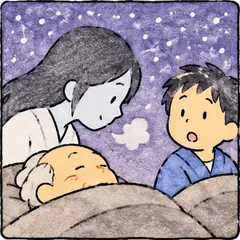
The snow woman, pale and dressed in white, who appears in blizzards. Her icy breath can freeze a traveller, yet in the most famous version of her story she spares a young man, on one condition. Read it in Japanese below.
座敷童子ざしきわらし · zashiki-warashi
A child spirit that lives in old houses, mostly in the north of Japan. It plays tricks at night, but a house with a zashiki-warashi prospers; if it leaves, the family's luck goes with it.
ろくろ首ろくろくび · rokurokubi
A woman who looks ordinary by day, but at night her neck stretches longer and longer while she sleeps. In some versions, the head comes off and flies away on its own.
化け猫ばけねこ · bakeneko
A cat that has lived too long becomes a bakeneko: it walks on two legs, talks, dances with a towel on its head, or takes the form of its owner. When its tail splits in two, it becomes a nekomata.
ぬらりひょんぬらりひょん · nurarihyon
An old man with a long, bald head who slips into houses at dusk, drinks tea and acts as if he were the master. Modern manga made him the leader of all yokai.
一反木綿いったんもめん · ittan-momen
A long strip of white cotton that flies through the night sky and wraps itself around people's faces. It comes from Kagoshima, in the south, and became famous thanks to the manga GeGeGe no Kitarō.
唐傘お化けからかさおばけ · karakasa-obake
An old paper umbrella with one eye, a long tongue and a single leg it hops on. It is a tsukumogami: in Japanese belief, an object that reaches a hundred years can come to life.
What does yōkai mean?
妖怪 is written with 妖 (bewitching, strange) and 怪 (mysterious): a yōkai is anything strange that people could not explain, whether a creature, a spirit or a phenomenon. Japanese also has 物の怪 (mononoke) and お化け (obake), the word children use for ghosts and monsters.
Yokai, yūrei and kami
幽霊 (yūrei) are the ghosts of the dead, usually women in white with long black hair. 神 (kami) are the gods and spirits of Shintō, honored in shrines. Yōkai sit in between: neither dead people nor gods, but beings of the world around us, the river, the mountain, the house, even old objects.
From the night parade to manga
Old picture scrolls show the 百鬼夜行 (hyakki yagyō), a night parade of a hundred demons. In 1776, the artist Toriyama Sekien drew catalogues of yokai that fixed their looks for centuries. In the 20th century, Mizuki Shigeru's manga GeGeGe no Kitarō made them popular again, and today they appear in anime and video games such as Yo-kai Watch.
Read yokai stories in Japanese
Our free folktales are written for learners, with furigana and a translation.
See also
Questions about yokai
What is a yokai?
A yōkai (妖怪) is a supernatural creature or phenomenon from Japanese folklore: river imps like the kappa, mountain spirits like the tengu, shape-shifting animals like the kitsune and the tanuki, and many more.
Are yokai evil?
Not all of them. Some are dangerous, like oni or yuki-onna, many are simply mischievous, like the tanuki, and some bring good fortune, like the zashiki-warashi. Most stories teach respect for nature and for old things.
What is the difference between a yokai and a ghost?
A ghost, 幽霊 (yūrei), is the spirit of a dead person. A yokai is a creature of its own, often linked to a place, an animal or an object, and was never human.
How many yokai are there?
Nobody knows: every region has its own, and new ones keep appearing, like the urban legends of the 20th century. Illustrated catalogues from the Edo period already list hundreds.
How do you say yokai in Japanese?
妖怪, read ようかい (yōkai), with a long o. In everyday speech, children also say お化け (obake) for monsters and ghosts.
Didn’t find your answer?
Write to us at contact@hinoko-japanese.com: we answer in English or French.